
HEALTHCARE MANAGEMENT FOR EXECUTIVES - HCA532 - 1.1

Content organized by Tamara Martins Vanini from the book Essentials of Managed Health Care, Sixth Edition by Peter R. Kongstvedt, 2012.
Health care in the USA
The health system in the United States is continually evolving. On this subject, it is known that change is the only constant. Since the passage of the Affordable Care Act (ACA), the American health system has faced more significant change than at any other time since the approval of Medicare and Medicaid during the 1960s.
In the USA, they operate exclusively public, other mixed and private health systems. In relation to public systems, the two largest are Medicaid and Medicare. Thus, the elderly are offered Medicare, a social insurance system created in 1965, funded by the federal government, which provides health care to the population over 65 years old, as well as for people under 65 years old with some disability and those of any age with chronic renal failure. Medicare includes hospital insurance, medical insurance, and coverage for certain medications.
Regarding Medicaid, the focus of health care is focused on people and low-income families. It is an insurance administered by the State that must provide health care to American citizens or citizens with permanent residence visas in the USA, which includes low-income adults, their children and people with disabilities.
Regarding health care in the USA, it can be understood that many citizens who do not fit the conditions of Medicare and Medicaid make use of private health plans. Thus, since there are several plans offered, they are distinguished in relation to the way the care is made, deductible amounts, co-participation and coverage.
In general, health insurance is offered by the companies in which citizens work. However, there is still the option for the citizen to directly contract a private plan, which should involve a higher cost.
Companies offer their employees a health plan as a benefit, but it is important to note that they pre-select plans with one or more health insurance companies. In this context, the employee will be able to choose between the plans they have contracted.
Some companies may offer variations of a plan of the same type by changing only coverage amounts, and other companies may offer various types of plans and coverages (some of which may be from different insurers). Thus, as part of employee benefits, companies generally must pay a portion of the plan; and the employee, the other party, or, in certain cases, the company may pay for the entire plan.
In the following box it is possible to better understand private assistance through the types of plans:
In addition, for a better understanding of how health plans work in the US, it is essential to have knowledge about: “premium”, “deductible”, “co-pay”, “co-insurance” and “out-of-pocket maximum”:
Throughout the studies of this first theme, it was possible to observe that the American health system is quite complex, which is why it is important that the distinctions between the different types of health care are understood.
Finally, it can be concluded that several changes in health care have occurred over the years to the present and that, certainly, the basic principles of health care will continue to evolve at the pace of the demands and needs of the population, the market and in accordance with government regulations.
To further deepen the theme, we will address in practice the general context of health in the USA. It is observed that public plans are directed to a specific population. In this regard, the population that does not fit the characteristics for health care by Medicare and Medicaid, for example, seeks private companies to contract health plans.
It is possible to relate, however, the great influence of the economy to the population's search for health care. In this context, at times when economic conditions improve, people have more disposable income (and, consequently, access to insurance coverage), which can be used to obtain health services. However, in times of economic crisis, there may be a reduction in disposable income, reducing spending on health by the population.
In addition, as previously seen, most health insurance for people under 65 is provided by their employers in the US. For this reason, in times of crisis and unemployment, people who have lost their jobs also end up losing their own health plan and that of their family. Such a situation should strongly shake health care organizations.
The Affordable Care Act (ACA) greatly influenced health insurance coverage in the United States. Studies have shown that ACA has reduced inequality related to health insurance coverage, particularly as a result of the expansion of Medicaid coverage.
Learn more about it through the article “Inequality in health insurance coverage before and after the Affordable Care Act”, available at the link: https://www.bit.ly/ad98y8.
To deepen your studies on the subject, read chapters 1 and 2 of Peter R. Kongstved's book “Essentials of Managed Health Care.
References
Kongstvedt, P.R. (2012). Essentials of managed health care. Burlington: Jones and Bartlett Learning, 6. ed.
Ledlow, G.R., Corry, A.P. & CWIEK, M.A. (2007). Optimize your healthcare supply chain performance. Chicago: Health Administration Press.
White, K.R. & Griffith, J.R. (2015). The well-managed healthcare organization. Chicago: Health Administration Pressed.
HEALTHCARE MANAGEMENT FOR EXECUTIVES - HCA532 - 1.1
Health care in the USA
Images: shutterstock


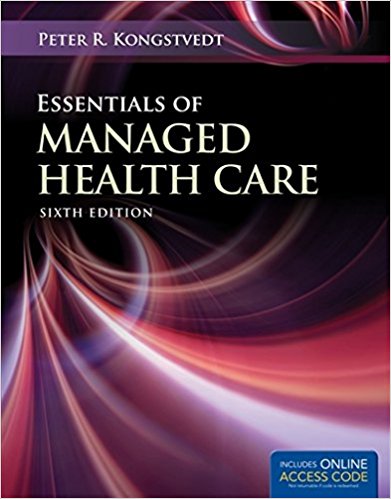
REFERENCE BOOK:
Essentials of Managed Health Care, Sixth Edition
Peter R. Kongstvedt
Jones and Bartlett Learning © 2012


MUST University®: licensed by Florida Commission for Independent Education, License: 5593.